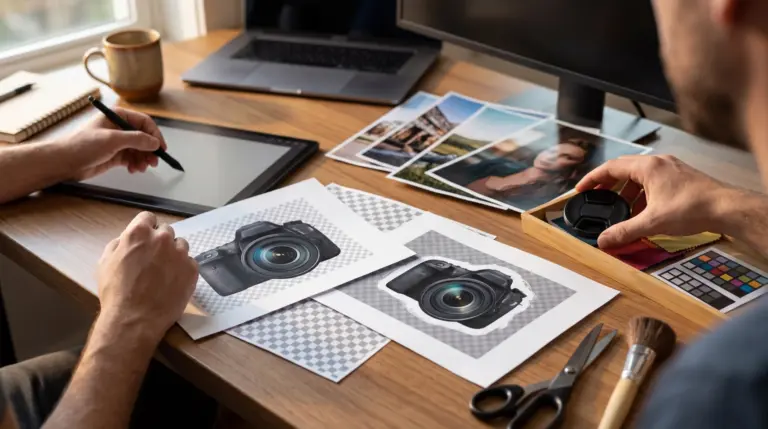
Free-cropping involves trimming an image based on composition and feel, ignoring standard dimensions like 4:5 or 2:3. Standard aspect ratios, on the other hand, adhere to predefined width-to-height proportions for printing and display consistency. Free-cropping prioritizes artistic vision over technical rules, allowing the image’s story to dictate its final shape.
Imagine this scenario: you’re standing at the edge of a canyon at sunrise, having just captured a breathtaking panorama. The camera saved it as a standard 3:2 image, but the real magic is in the long, thin slice of light hitting the canyon walls. Sticking to a common aspect ratio would mean including a dull, empty sky or foreground, which would diminish the drama of the moment. This is the classic dilemma for photographers: serving the composition or the constraints of a frame.
Many photographers, especially those starting out, are taught to respect traditional aspect ratios for practical reasons like printing and social media display. This adherence, however, can hold back your best work. Sometimes, the most powerful version of your photo exists in a shape you haven’t considered yet.
What Is Free Cropping and How Does It Differ from Standard Aspect Ratios?
Free-cropping, also known as freeform cropping, is the practice of trimming an image based purely on your artistic eye and the needs of the composition. You are not locked into any fixed width-to-height ratio. This approach stands in direct contrast to cropping with standard aspect ratios, which conform to established dimensions rooted in the history of film, paper, and digital screens.
A standard image aspect ratio is the proportional relationship between an image’s width and its height. These standards arose from technical and commercial needs. For instance, the 3:2 ratio is common because it matches the 35mm film standard used by most DSLR and mirrorless cameras. Other common ratios include:
- 4:3: Used by many smartphones and Micro Four Thirds cameras.
- 1:1: The classic square format, popularized by Instagram.
- 16:9: The standard for widescreen video and modern displays.
- 4:5: A popular vertical format for social media posts.
Free-cropping ignores these presets. The final dimensions might be 2.75:1 or 1:3.14—it doesn’t matter. What matters is that the crop strengthens the image by removing distractions and guiding the viewer’s focus. In practice, what I see most often is that photographers use free-cropping to let the subject dictate the frame, rather than forcing the subject into a pre-made box.
| Feature | Free-Cropping | Standard Aspect Ratios |
|---|---|---|
| Primary Goal | Artistic Composition | Presentation Consistency |
| Constraint | None (guided by eye) | Fixed width-to-height ratio |
| Best For | Unique digital displays, artistic prints, maximizing impact | Standard frames, cohesive web galleries, specific print sizes |
| Workflow | Intuitive, creative, “by feel” | Structured, rule-based, predictable |
When Should Nature Photographers Use Non-Standard Aspect Ratios?
Nature photographers should use non-standard aspect ratios when the subject or the emotion of the scene feels constrained by a standard frame. Nature rarely fits neatly into a 3:2 box, and forcing it to can weaken the photograph’s impact. Opting for a custom crop is a deliberate creative choice, not a failure to compose in-camera.
Consider these specific scenarios where non-standard aspect ratio photography excels:
- Emphasizing Scale and Grandeur: A vast mountain range or a sprawling desert landscape often benefits from a wide panoramic crop, like 2:1 or even 3:1. This shape mimics how our eyes scan a horizon, immersing the viewer in the scene’s immense scale.
- Isolating a Vertical Subject: Picture a towering waterfall or a majestic, ancient tree. A tall, thin vertical crop (for example, 2:5) can eliminate distracting elements on either side, forcing the viewer’s eye to travel upward and appreciate the subject’s height and form.
- Following Natural Lines: A winding river, a curved shoreline, or a road disappearing into the distance are powerful leading lines. A freeform crop can be shaped to enhance this flow, creating a dynamic energy that a standard rectangle might disrupt.
- Removing Distractions for a Cleaner Story: Sometimes the most compelling composition is simply what remains after you’ve trimmed away a distracting bright rock in the foreground or an uninteresting patch of sky. If the resulting shape is unusual, so be it. The story is stronger.

How Do You Free-Crop Images in Adobe Lightroom and Photoshop?
In both Adobe Lightroom and Photoshop, you can free-crop by selecting the Crop Tool and disabling the aspect ratio lock. This allows you to drag the cropping handles independently to create any custom shape you desire. The process is straightforward in both applications.
In Adobe Lightroom Classic, the steps for a freeform crop are simple. First, enter the Develop module and select the Crop Tool (keyboard shortcut ‘R’). Look for the dropdown menu next to the padlock icon; it will likely show ‘Original’ or a numerical ratio. Click this and either select ‘Custom’ or just click the padlock to unlock it. Once unlocked, you can drag each edge and corner of the crop box freely to find the perfect composition.
The workflow for a freestyle crop in Photoshop is very similar. Select the Crop Tool from the toolbar (shortcut ‘C’). In the options bar at the top of the screen, you will see fields for width, height, and resolution. Ensure these are empty. Alternatively, you can click the dropdown menu (which might say ‘Ratio’) and select ‘W x H x Resolution,’ then clear the fields. This removes all constraints, allowing you to adjust the crop overlay to any dimension.
Mini Case Study: The Giraffe and the Acacia
A wildlife photographer I know captured a beautiful shot of a giraffe stretching its long neck to eat from a tall acacia tree in Tanzania. The original 3:2 horizontal image was good, but it included a lot of empty, uninteresting savanna on the left and right, which diluted the subject’s impact. The photographer’s goal was to emphasize the incredible height of both the animal and the tree. A standard vertical crop (like 4:5) felt too restrictive and cut off the environmental context. Using a freestyle crop in Photoshop, they created a custom 2:5 vertical image. This elegant, narrow frame focused all attention on the interaction between the giraffe and the tree, conveying a powerful sense of scale and grace. The result was surprising: the uniquely cropped image received over 50% more engagement on their portfolio website compared to their other standard-ratio photos from the same trip.
What Are the Creative Benefits of Breaking Traditional Aspect Ratio Rules?
Breaking traditional aspect ratio rules liberates you to prioritize the story and emotional core of your image above all else. It provides complete compositional freedom, allowing you to guide the viewer’s eye with precision, create unique visual tension, and distinguish your work in a crowded digital landscape filled with standard-sized photos.
The main creative benefits include:
- Enhanced Storytelling: The shape of your frame is a powerful narrative tool. A wide, panoramic crop can evoke feelings of freedom or isolation. A tight square crop can create a sense of intimacy or claustrophobia. You are shaping the viewer’s emotional response.
- Compositional Purity: With free-cropping, you build the frame around the composition, not the other way around. This is the essence of cropping for composition. You no longer have to compromise your subject’s placement to fit a predefined box.
- Developing a Unique Style: Consistently using custom aspect ratio photography can become a recognizable part of your artistic signature. Photographers like Peter Lik are famous for their panoramic formats, which immediately sets their work apart.
- Creating Visual Flow: A custom crop can direct the viewer’s gaze more effectively than a standard one. By trimming away non-essential areas, you create a clear path for the eye to follow, leading directly to the focal point of your image.
What Are Some Common Misconceptions About Aspect Ratios and Cropping?
A significant misconception is that professional photographers must always adhere to standard aspect ratios to be taken seriously. Another common myth is that free-cropping is an amateurish mistake, when many accomplished artists crop by eye to serve the image’s story first and foremost.
Let’s address some of these outdated ideas:
- Myth 1: “You lose too many pixels.” While you are discarding data when you crop, today’s high-resolution cameras give you incredible flexibility. A common mistake I find is photographers being too afraid to crop. Even after a significant crop on a 45-megapixel image, you often have more than enough resolution for a large, sharp print. The compositional improvement is almost always worth the pixel loss.
- Myth 2: “It’s too expensive or difficult to print and frame.” This may have been true decades ago, but it’s no longer a major hurdle. Many online printing labs and framing services can produce high-quality prints, metal prints, or acrylics in any custom size you specify. The cost difference is often minimal compared to standard sizes.
- Myth 3: “It looks messy in a portfolio or on social media.” While consistency has its place, a varied presentation can also be dynamic and engaging. For platforms with rigid formats, the solution is simple: place your custom-cropped photo onto a neutral background that fits the required dimensions (e.g., a 4:5 canvas for Instagram). This maintains your artistic crop while ensuring social media consistency.
- Myth 4: “Standard ratios are inherently more beautiful or artistic.” Many standard ratios were born from technical necessity, not a universal law of aesthetics. While concepts like the Golden Ratio exist, they are compositional guides, not rigid rules. The most artistic choice is the one that best serves your specific photograph.
The debate between aspect ratios and free-cropping is about control versus freedom. While standard ratios offer predictability and ease of use, they can also act as creative handcuffs. Free-cropping puts the storytelling power back in your hands, allowing the subject to define its own frame. The next time you open an image to edit, try this: unlock the crop tool and ignore the presets. Drag the handles freely until the composition feels right, and see what new story emerges when you are no longer confined to a box.
FAQ
Does free-cropping affect image quality?
Cropping reduces an image’s total pixel count, which can limit its maximum print size. However, with modern high-resolution cameras, you can often crop significantly and still retain more than enough detail for large, high-quality prints and digital displays.
How do I post non-standard aspect ratios on social media?
For platforms like Instagram with fixed dimensions, you can place your custom-cropped image onto a standard-sized canvas (e.g., a 4:5 or 1:1 background). This technique, often called ‘letterboxing,’ preserves your original composition without it being awkwardly auto-cropped by the platform.
Are there any tools to help me crop to custom aspect ratios online?
Yes, many free online tools allow for unconstrained cropping. For example, a free <a href=”https://araluma.com/tools/crop”>image cropper</a> lets you drag the handles to any dimension you need and download the result without installing complex software like Photoshop.
Should I compose for a specific aspect ratio in-camera?
It’s generally better to shoot using your camera’s full sensor to capture the maximum amount of data. This gives you the most flexibility to experiment with different crops in post-processing. Composing for the final crop in-camera can be restrictive if you later change your mind.
Crop and resize images for free